★ In-house computing hardware:
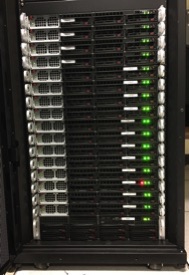
★ Nanochem1, a Linux cluster built by Aspen Systems which has
★ A head node of 16 AMD Opteron cores and 64 GB Memory
★ 16 compute nodes: each has 64 AMD Opteron cores and 128 GB Memory
★ Total: 1040 cores and 2176 GB Memory
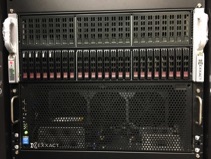
★ Nanochem2, a Linux GPU server built by Exxact, featuring two Intel Xeon E5-2620 6-core CPUs with eight Nvidia GTX 980 GPU cards.
★ Total: 12 cores; 24 hyperthreads; 64 GB Memory
★ Nanochem3, a Linux GPU server built by Exxact, featuring two Intel Xeon E5-2620 8-core CPUs with eight Nvidia GTX 1080 GPU cards.
★ Total: 16 cores; 32 hyperthreads; 128 GB Memory
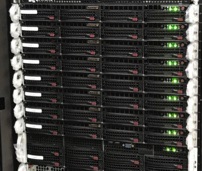
★ Nanochem4: a Linux cluster built by Aspen Systems which has
★ A head node of 16 Intel Xeon Silver 4110 (Skylake) cores and 96 GB Memory
★ 8 compute nodes: each has 32 Intel Xeon Gold 6130 (Skylake) cores and 96 GB Memory
★ Total: 272 cores and 864 GB Memory
★ Nanochem5, a home-built Linux workstation which has an Intel Xeon E7 6-core processor with three Nvidia GTX 980 GPU cards.
★ Nanochem6, a home-built Linux workstation featuring an Intel Xeon E7 6-core processor with two Nvidia GTX 980 GPU cards.
★ Nanochem7, a Linux workstation built by Titanus which has 20 Intel Xeon E5-2600 v2 cores and 128 GBMemory.
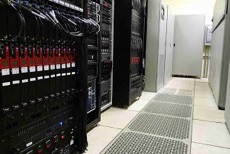
★ UCR High-Performance Computing Center: A hybrid high-performance computing system consists of:
★ 4 head nodes
★ 48 AMD compute nodes (64 cores and 512 GB memory per node; 3072 total cores)
★ 40 Intel compute nodes (each with 32 Intel Broadwell cores and 512 GB memory; 1280 total cores)
★ 6 Intel large-memory compute nodes (32 cores and 1024 GB memory per node; 192 cores total)
★ 4 GPU compute nodes each with 32 (HT) cores Intel Haswell CPUs: 2 nodes, each with 2 x NVIDIA Tesla K80 GPUs 128 GB RAM; 2 nodes, each with 4 x NVIDIA Tesla K80 GPUs (~10000 CUDA cores each) and 128 GB memory
★ Supercomputing access
★ Our group has annual allocation of ~5 million CPU hours at National Energy Research Scientific Computing Center (NERSC), the primary scientific computing facility for the Office of Science in the U.S. Department of Energy and operated by Lawrence Berkeley National Laboratory.